The contribution of technology to workplace safety is increasingly relevant, both in preventing possible accidents and in detecting them, as well as in providing tools that allow for more timely and effective rescue operations.
Let’s consider an example. You are a company with a large number of operators engaged in various activities: from handling goods in warehouses to high-altitude plant maintenance interventions. YouManDown, within the YouWorkForce solution, assists your operators in both indoor and outdoor activities:
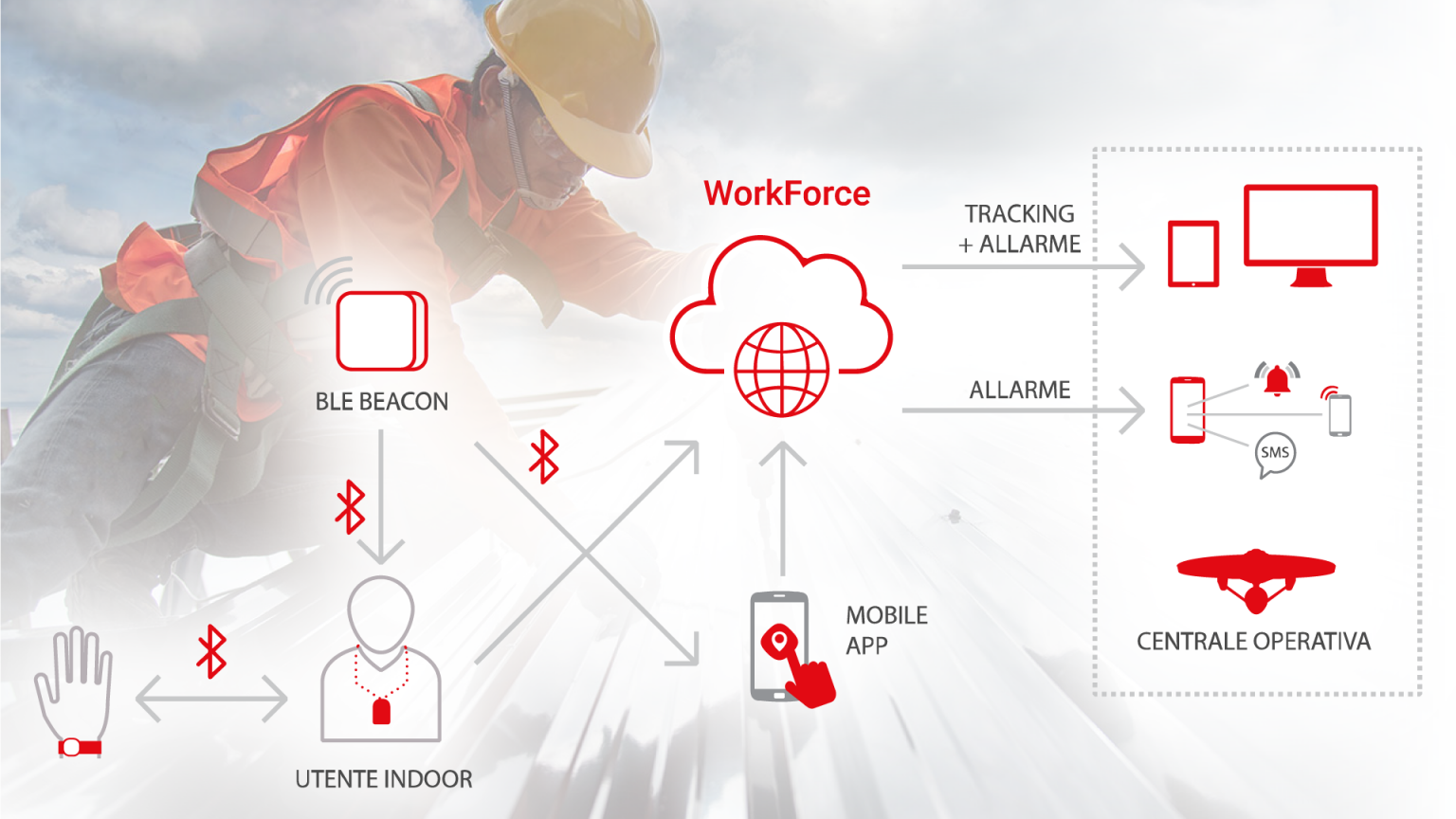
- smartphones and wearable devices, equipped with SIM cards and accelerometers, collect information on the operator’s status;
- if they detect anomalies, they communicate them to your central console: the console activates a series of planned actions.
Let’s imagine having an operator engaged in maintenance work on a high-altitude repeater, without colleagues who can assist in case of injury or illness. Through smartphone and/or wearable device, YouManDown can trigger 3 types of alarms:
- sudden fall: detected by the accelerometer, the device immediately sends an alarm to the operations center, which triggers planned events such as phone calls, sending SMS or emails to a predefined contact list. Similarly, using wearable devices, it’s possible to identify even more specific states, such as torso inclination, which allows understanding if the user is lying down and therefore potentially in difficulty, even in the absence of a sudden fall.
- Lack of movement: after a certain period of time without recording any movement, the device automatically sends an alarm to the operations center.
- SOS: in this case, it’s the operator themselves who sends the rescue request.
YouManDown assists operators in a similar way even in indoor situations, or within underground tunnel networks characterized by lack of coverage. In these cases, the system integrates Bluetooth beacons that compensate for the lack of coverage, ensuring operator monitoring and communication between detection devices and the central console. What is tracked is the device – not the operator – exclusively at the moment when the event that configures the need for rescue is recorded, eliminating any potential privacy issues.